Farnham Wood
The Chemistry of DeathFarnham Wood is the woodland bordering the marsh where Neil Yates and Sam Yates find Sally Palmer’s remains, making it the first decisive crime scene in the Manham investigation. Introduced through the boys’ summer walk and the natural processes that lead them to the discovery, the wood is both a specific rural landscape and the setting in which apparently ordinary traces acquire forensic meaning.
Setting and approach
The discovery occurs in the second week of July, during a prolonged spell of heat. The boys are walking toward a reed pond where they expect to meet friends and swim. The weather has baked the ground hard and drained colour from the trees; this matters not only to the atmosphere but also to the evidence, since warm, dry conditions accelerate decomposition and allow traces to persist across the grass.
The route into the wood begins at the marsh edge. Neil, the elder brother, walks ahead, while Sam follows behind and notices a line of larvae. The boys’ curiosity draws them away from their intended outing and toward the source of the trail. Their discovery follows the direction of an ecological trace rather than a deliberate search: the landscape leads them, step by step, from the marsh grass to the hidden crime scene.
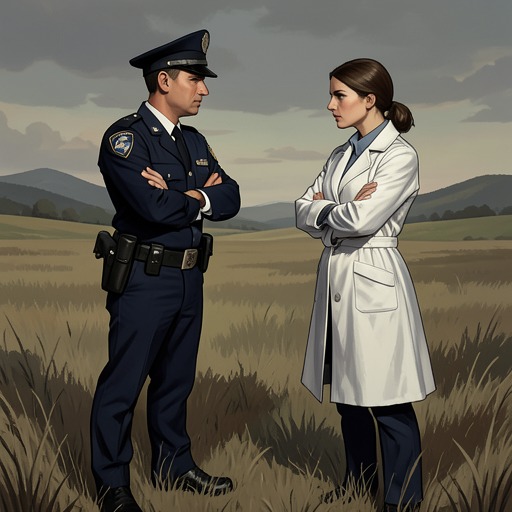
The wood is accessible by a track across the marsh, only a few hundred yards from the point where David Hunter directs two police officers. The approach is sufficiently straightforward to describe, but the heat makes the journey an immediate physical inconvenience for the officers. In this way, the setting is not remote wilderness; it lies within reach of the village, though its surrounding marsh and trees can still conceal what has happened there.
The discovery and its human context
The larvae lead the boys to Sally Palmer’s body at the edge of the wood. The narration presents their actions as a reconstruction: Neil appears to take the lead, with Sam following his older brother, before both return home and then go to the police station. Their walk transforms the wood from a place of recreation into the point at which the village’s hidden violence becomes undeniable.
The discovery also exposes how little the community had noticed Sally’s absence. She had failed to collect a grocery order and stopped visiting the newsagent for her daily newspaper, but no one had reported her missing. People assumed she had gone away or was occupied with writing. The contrast is sharp: the wood preserves physical traces of what happened, while the village’s social ties prove too loose to register promptly that Sally has vanished.
Forensic landscape
Hunter reads the remains and the ground around them as a connected system. Blowfly activity provides an initial time estimate: the larvae are at a stage consistent with a body having been present for between one and two weeks. The absence of empty pupal cases limits how long the insects could have completed their cycle there. Combining that evidence with the local heat, Hunter’s preliminary estimate is approximately nine or ten days, while he stresses that conditions make a precise answer impossible.
The grass offers a second line of evidence. As the body decomposes, chemical products alter the soil and kill vegetation, leaving a trace that marks where material has affected the ground. Hunter identifies brittle, crumbly adipocere and relates its condition to rapid decomposition in hot weather. The wood is therefore more than a hiding place: its vegetation and soil record the interaction between the body, insects, and climate.
Later comparisons reinforce the need to read such signs cautiously. At an animal carcass examined elsewhere in the investigation, Hunter notes that beetles tend to appear later than flies and maggots, as decay progresses. Their presence or absence can help establish a sequence, but he warns that insects are not perfectly reliable indicators and that other variables must be considered. The forensic meaning of Farnham Wood consequently depends on interpretation, not on any single natural clue.
Search, traces, and changing interpretations
The woodland also forms part of the search for Lyn Metcalf. When Lyn does not return from her run, Marcus Metcalf follows her route into the reedbeds and wood. There he finds a dead mallard tied to a standing stone. His first response is anger at the needless cruelty; fear follows when he cannot dismiss the bird as unrelated to Lyn’s absence. Later, Lyn’s stopwatch, found near a tree root, further changes the meaning of the search: the missing runner’s route has become a place where objects point toward danger.
The animal remains connect this episode to a wider pattern of possible markers. Mackenzie reports that Sally had complained about a dead stoat left on her doorstep. Considered alongside the swan wings found with Sally and the mallard in the wood, the incident raises the possibility that animals have been used as warnings or signatures. The evidence supports a recurring association, but not certainty about the meaning of every individual trace.
A separate woodland excavation produces an adult skeleton that is not Lyn. It has no soft tissue and appears to have been there since long before her disappearance. This discovery prevents the search from collapsing into a single explanation: the wood contains evidence from different times, and an apparent connection to the immediate crisis may prove false. Elsewhere in the investigation, forensic examination of another woman’s body suggests she was killed in a different place and deposited where she was found, further distinguishing the site of discovery from the site of death.
Narrative significance
Farnham Wood concentrates the novel’s tension between rural familiarity and concealed danger. The boys know the countryside well enough to recognize the ordinary rhythms of insects and animal life, yet that familiarity cannot prepare them for what the trail leads to. The same natural processes that make the discovery possible also complicate the investigation, because heat, soil, vegetation, and insect development all alter the evidence.
The wood is a beginning, not a complete explanation. Its clues invite successive hypotheses, from the significance of animal remains to the identity and movements of the killer, while later findings complicate the first assumptions. By making the landscape legible through forensic observation but never wholly self-explanatory, the novel turns Farnham Wood into both a crime scene and a test of how carefully its human investigators distinguish a trace from a conclusion.